The graduate with a commerce degree enters the interview room with good grades and sound knowledge of accounting concepts. The interviewer is impressed with his theoretical knowledge, but then he asks him some basic questions: “Can you make GST entries in Tally? Have you worked on SAP? Can you reconcile bank statements with actual figures of the business?” The candidate looks uncomfortable.
This is becoming a regular occurrence. In various sectors, the focus of recruiters has shifted to new preferences. Academic credentials indeed matter, but the actual accounting skills may decide whether or not someone is hired by a business.
Industry Trend
The field of accounting has witnessed considerable change in the last ten years. The use of digital accounting, GST compliance, ERP software, cloud accounting software, and automation has completely changed the process of managing finances. Companies now need accountants who can utilize their technical skills along with their understanding of the software.
The changing industry trend is leading to an increased need for skilled professionals who can apply what they know in practical workplace situations. Institutes that focus on real projects, accounting software, and real business scenarios are now becoming more important due to the fact that institutes prepare students for practical workplace needs. Tally, SAP, BUSY, GST, Payroll, Computax, and Advanced Excel are part of these institutes’ curriculum, along with live projects.
Expert Commentary
Accounting concepts form the foundation of every finance career, but practical application transforms knowledge into professional competence. Employers rarely expect fresh graduates to know every accounting standard in detail. Instead, they value candidates who understand how accounting works inside a business.
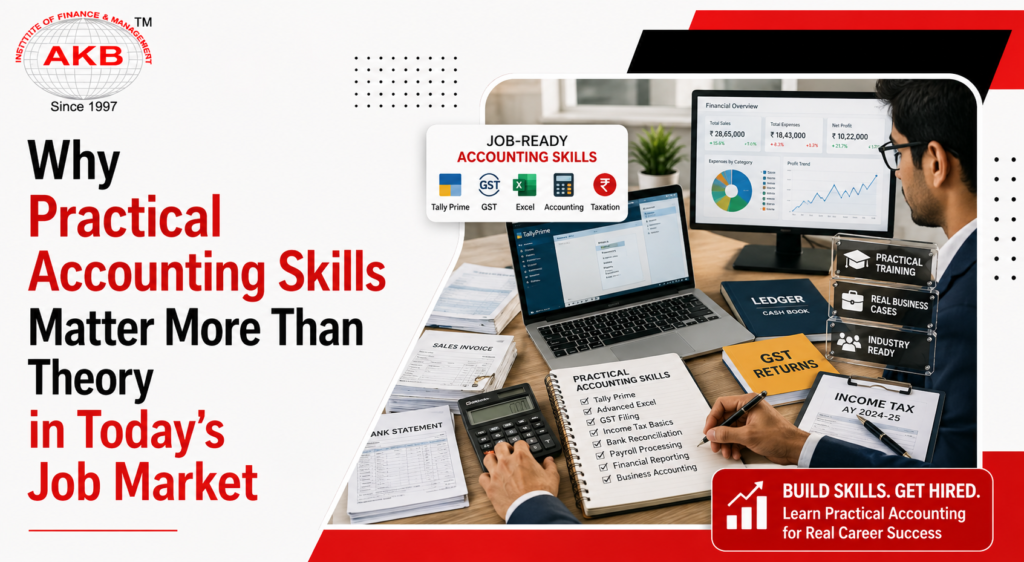
A Practical accounting course in Faridabad helps learners bridge this gap by exposing them to real accounting workflows, software applications, taxation procedures, payroll management, and financial reporting. Instead of solving textbook problems, students learn to handle customer invoices, supplier accounts, GST returns, bank reconciliations, and month-end reporting.
Professionals generally recommend focusing on three areas while learning accounting:
- Practical software experience
- Real business documentation
- Industry-standard financial processes
When these skills complement theoretical education, learners become significantly more employable.
Proof & Real-World Perspective
Organizations across manufacturing, retail, healthcare, logistics, construction, IT, and professional services rely on integrated accounting systems every day. These businesses require accountants who understand software as well as financial principles. Consider two candidates applying for the same Accounts Executive role.
The first candidate has excellent academic knowledge but limited practical exposure. The second candidate has completed a Practical accounting course in Faridabad and has worked on live accounting entries using Tally, SAP, GST modules, BUSY, and Excel. Most employers are likely to prefer the second candidate because they require less training and can contribute immediately.
Training providers that integrate practical software, live case studies, and workplace simulations consistently prepare students more effectively for accounting roles. AKB Institute, for example, structures its accounting programs around live company documents, software-based learning, and placement-oriented training.
Analysis
The difference between theoretical accounting education and practical accounting training becomes much clearer when comparing workplace expectations.
| Theory-Based Learning | Practical Accounting Training |
| Focuses on concepts | Focuses on implementation |
| Classroom exercises | Live business scenarios |
| Manual problem-solving | Software-based accounting |
| Limited exposure to industry tools | Hands-on experience with ERP and accounting software |
| Academic confidence | Workplace confidence |
The benefits of practical learning include:
- Better interview performance
- Faster workplace adaptation
- Improved software proficiency
- Greater confidence in handling financial transactions
- Stronger understanding of taxation and compliance
- Higher employability
However, students should also avoid several common mistakes.
Relying only on textbooks
Many learners assume academic marks alone will secure employment.
Ignoring accounting software
Modern businesses expect familiarity with Tally, SAP, BUSY, Excel, and taxation software.
Avoiding practical assignments
Hands-on practice develops confidence far more effectively than theoretical revision.
Neglecting communication skills
Accountants regularly interact with clients, auditors, vendors, and management teams.
Recommendations
Students planning careers in accounting or finance should focus on developing a balanced skill set that combines conceptual understanding with practical application.
Before choosing a training program, consider whether it includes:
- Practical accounting exercises
- Live projects
- Industry-standard software
- GST and Income Tax modules
- Payroll processing
- SAP and ERP exposure
- Resume preparation
- Mock interviews
- Placement assistance
A Practical accounting course in Faridabad should not simply teach accounting principles. It should simulate real business environments where learners perform accounting tasks using actual business documents and professional software.
Another important recommendation is continuous upskilling. Technology continues to reshape finance functions, making it essential for professionals to regularly update their knowledge in ERP systems, automation, compliance, reporting, and financial analysis.
Building expertise across multiple software platforms also improves career flexibility. Professionals who understand accounting alongside Tally, SAP, GST, Payroll, and Advanced Excel are better positioned to adapt to changing business requirements.
Closing Thoughts
Today’s accounting profession rewards professionals who can translate financial knowledge into practical business results. While theoretical education remains important, employers increasingly prioritize candidates who understand software, compliance, reporting, and real accounting workflows. A Practical accounting course in Faridabad provides learners with this practical exposure, helping them become job-ready from the beginning of their careers. Through live projects, industry-focused training, exposure to modern accounting software, and placement-oriented learning, AKB Institute of Finance & Management (AKBIFM) equips aspiring accountants with the practical expertise required to succeed in today’s competitive finance industry.