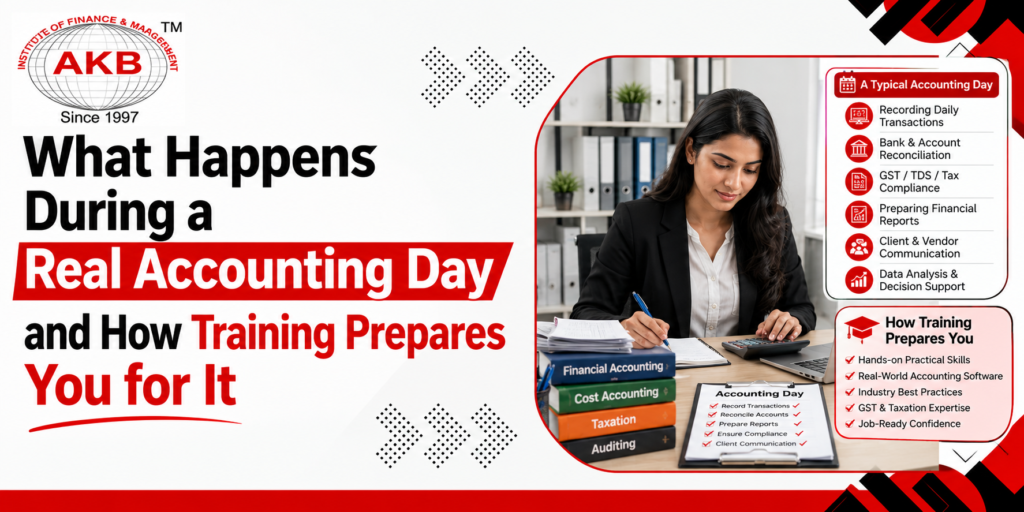
A real accounting day involves more than simply entering numbers into a ledger. An accounting professional often starts by checking transactions and invoices, recording purchases and sales, reconciling accounts, reviewing GST information, preparing reports, and answering questions from departments. The ability to do these tasks accurately comes from hands‑on experience, not just theory. Accounting training in Faridabad can prepare learners for this setting by blending accounting fundamentals with software practice, taxation, bookkeeping, reconciliation, Excel, and realistic business scenarios.
Key Takeaways
- Accounting professionals handle interconnected accounting tasks during a normal working day.
- Practical accounting requires accuracy, organisation, software knowledge, and problem‑solving.
- GST, bookkeeping, reconciliation, and reporting are often part of finance work.
- Practical training helps students understand how accounting concepts are applied in businesses.
- Software skills become more useful when learners understand the accounting principles behind them.
- Workplace‑oriented training can improve confidence when students transition into accounting roles.
What Is a Real Accounting Day Like?
Accounting Begins With Reviewing Financial Activity
A typical accounting day often starts with reviewing the previous day’s financial activity. Depending on the organisation, this may include checking sales invoices, purchase bills, receipts, payments, bank transactions, and other financial records.
The accountant must ensure that transactions are recorded under the appropriate accounts and that supporting documents are available. A small error at this stage can affect subsequent reports, reconciliations, or tax-related information.
This is why accounting training in Faridabad should not focus exclusively on definitions and formulas. Learners need to understand how individual transactions move through an organisation’s accounting system.
The Day Can Involve Multiple Responsibilities
Accounting work varies according to the organisation and role, but a professional may handle several activities within the same day.
These can include:
- Recording sales and purchase transactions
- Maintaining ledgers and books of accounts
- Checking invoices and supporting documents
- Updating accounting software
- Reconciling bank and ledger information
- Reviewing GST-related transactions
- Preparing financial or MIS reports
- Following up on missing financial information
The variety is one reason accounting careers require both technical knowledge and the ability to prioritise tasks.
Why Does Practical Accounting Training Matter?
Theory Explains the Concept, Practice Explains the Process
A student may understand what a journal entry is but still hesitate when presented with an unfamiliar business transaction. Real accounting requires the professional to determine what the transaction means, which accounts are affected, how it should be recorded, and what supporting information is required.
Practical exercises allow learners to make these decisions repeatedly. Over time, the process becomes more familiar and helps reduce hesitation when facing similar workplace situations.
A strong accounting training in Faridabad programme can therefore connect classroom concepts with transaction-based practice.
Accounting Software Is Part of the Daily Workflow
Modern accounting departments depend heavily on digital tools. Professionals may use accounting software for entries, invoicing, ledgers, reporting, inventory-related records, and other financial processes.
However, knowing where to click is not enough. Learners need to understand why a transaction is entered in a particular way and how that entry affects financial records.
This is where software training becomes more effective when combined with accounting fundamentals.
What Accounting Tasks Should Training Prepare You For?
Bookkeeping and Transaction Recording
Bookkeeping forms the foundation of many accounting roles. Training should help learners understand how business transactions are classified, recorded, and organised.
Students can practise transactions involving sales, purchases, expenses, receipts, payments, and other common business activities. Such exercises create familiarity with the flow of everyday accounting work.
GST and Tax-Related Accounting
GST can appear across multiple accounting activities, particularly when businesses record sales and purchases or review invoices.
Practical accounting training in Faridabad can help learners understand how GST-related information connects with accounting records rather than treating taxation as an entirely separate subject.
Learners can develop familiarity with areas such as:
- GST-related invoice information
- Input tax credit concepts
- Taxable transactions
- GST-related record maintenance
- Basic reconciliation concepts
The objective is to understand the accounting context in which taxation information is used.
Bank and Ledger Reconciliation
Reconciliation is another task that can require considerable attention to detail. An accountant may need to compare records, identify differences, investigate discrepancies, and ensure that information is properly accounted for.
Training through practical examples can help students understand that reconciliation is not simply about matching two numbers. It involves investigating why differences exist and determining what action is required.
Key Factors to Consider in Practical Accounting Training
Realistic Business Scenarios
The quality of practice matters. Exercises should resemble situations that accounting professionals may encounter rather than relying only on straightforward textbook questions.
Accounting Software Exposure
Learners should have opportunities to work with commonly used accounting software and understand how transactions, ledgers, reports, and other processes function within digital systems.
GST and Compliance Awareness
Accounting professionals should understand how taxation requirements interact with financial records. Practical exposure can make these concepts easier to apply.
Excel and Reporting Skills
Excel remains useful for organising, analysing, and presenting financial information. Learners should ideally develop skills such as data organisation, formulas, sorting, filtering, and basic reporting.
Accuracy and Documentation
Good accounting is not only about completing an entry. Professionals must maintain supporting records and develop habits that reduce errors.
Benefits / Advantages of Real-World Accounting Training
Greater Workplace Confidence
Students who practise accounting tasks before entering a job can feel more comfortable when they encounter similar responsibilities at work.
Accounting training in Faridabad can provide structured practice that allows learners to make mistakes, understand corrections, and repeat processes before facing actual workplace deadlines.
Better Understanding of Business Transactions
Practical exercises demonstrate how accounting works within a business rather than presenting each concept in isolation.
For example, a sales transaction can involve invoicing, accounting entries, GST considerations, customer records, and reporting. Seeing these connections provides a broader understanding of finance operations.
Stronger Job Readiness
Employers often need entry-level professionals who can contribute to routine accounting work with appropriate supervision. Practical exposure can help candidates demonstrate that they understand how accounting tasks are performed.
Improved Problem-Solving Ability
Real accounting does not always provide perfect information. A missing invoice, incorrect entry, or unexplained reconciliation difference can require investigation.
Practical learning helps students develop the habit of asking what caused an issue and how it should be resolved.
Common Mistakes / Challenges
Learning Software Without Understanding Accounting
Knowing software menus without understanding accounting principles can lead to incorrect entries. Software should support accounting knowledge, not replace it.
Treating GST as Memorisation
GST-related learning becomes more useful when students understand its connection with actual transactions and records.
Ignoring Reconciliation
Some learners focus heavily on data entry and overlook reconciliation. However, checking financial information is an important part of maintaining reliable records.
Practising Only Easy Transactions
Real businesses deal with varied situations. Students should gradually move from basic transactions to more complex scenarios involving adjustments, discrepancies, taxation, and reporting.
Focusing Only on Certification
A certificate can document completion of training, but practical ability demonstrates what a learner can actually do. Students should focus on building usable skills alongside credentials.
How to Choose Practical Accounting Training
Look Beyond the Course Name
When comparing accounting training in Faridabad, learners should examine the actual curriculum and teaching approach rather than choosing a programme based only on its title.
Important areas to evaluate include:
- Practical bookkeeping exercises
- Accounting software training
- GST and taxation concepts
- Excel and financial reporting
- Reconciliation practice
- Realistic business assignments
- Trainer experience
- Interview and workplace preparation
Build Skills in a Logical Sequence
Accounting skills are easier to develop when learned progressively. Students can begin with accounting fundamentals and bookkeeping before moving into software, GST, reconciliation, reporting, and more advanced applications.
This creates a stronger foundation than attempting to learn every tool and process simultaneously.
Expert Perspective / Practical Insight
Think Like an Accountant, Not Just a Data Entry Operator
One of the most useful habits for an aspiring accounting professional is to understand the reason behind every entry.
Before recording a transaction, ask what happened in the business, which accounts are affected, whether supporting documentation is available, and what impact the transaction may have on financial records.
This approach develops professional judgement.
Practise the Complete Accounting Workflow
Instead of practising isolated tasks, learners can work through a complete business scenario. For example, they might record purchases, create sales entries, account for expenses, review GST information, reconcile transactions, and prepare a basic report.
This type of practice reflects the interconnected nature of actual accounting work.
Accounting training in Faridabad is most valuable when it helps learners develop this end-to-end understanding and prepares them to approach everyday finance responsibilities systematically.
Frequently Asked Questions
What does an accountant typically do during a working day?
An accountant may record transactions, check invoices, maintain ledgers, reconcile accounts, review GST information, prepare reports, and coordinate with other departments depending on their role.
Is practical training important for accounting jobs?
Yes. Practical training helps learners apply accounting concepts to realistic transactions and become familiar with software, documentation, reconciliation, taxation, and reporting processes.
What software should accounting students learn?
The appropriate software depends on the target role and employer. Tally and other accounting systems are commonly used, while Excel is also valuable for organising and analysing financial information.
Can freshers learn practical accounting skills?
Yes. Freshers can develop practical skills through structured exercises, simulated business transactions, accounting software practice, and guided assignments.
Does GST knowledge help accounting professionals?
GST knowledge can be useful because taxation-related information frequently connects with sales, purchases, invoices, accounting records, and reconciliation activities.
What should I look for in accounting training?
Look for training that combines accounting fundamentals with practical bookkeeping, software, GST, Excel, reconciliation, reporting, and realistic business scenarios.
Final Thoughts
A real accounting day is rarely limited to one repetitive task. It involves moving between transactions, documents, software, taxation, reconciliation, reporting, and problem-solving while maintaining accuracy throughout the process. Students who experience these activities during training can enter the workplace with a clearer understanding of what accounting actually demands.
For aspiring finance professionals, accounting training in Faridabad can be a valuable step toward developing practical, job-oriented capabilities. AKB Institute of Finance & Management focuses on career-oriented financial education that can help learners connect accounting concepts with practical workplace requirements. The right training is not simply about completing a syllabus; it is about developing the confidence and competence to handle the realities of an accounting role.