The new commerce graduate has a thorough understanding of accounting principles and financial concepts, but when asked in an interview about the process of filing GST, accounting software knowledge, bank reconciliation, payroll process, and preparation of business reports, he finds his knowledge is lacking.
And the mismatch between classroom education and job requirements has become one of the biggest obstacles faced by people aspiring to make a career in the field of accounting. In modern times, businesses do not require people with knowledge of accounting; rather, they require professionals with practical knowledge of accounting.
Modern times have made it essential for accounting professionals to have practical exposure, know software, and handle finances. That is why the decision to get the best accounting course in Faridabad has become imperative for students and professionals.
Industry Insight: Why Accounting Jobs Are Changing Rapidly
The field of accounting has changed greatly due to technological advancement, automation, and changes in the demands of businesses. Manual accounting techniques have been overtaken by computerized accounting techniques, ERP systems, and automated finance applications.
Companies are now using tools like Tally, SAP, BUSY, Excel, and Taxation applications for managing their financial operations. Consequently, organizations now want individuals who possess knowledge of accounting and business applications.
A professional accountant today is expected to handle:
- Financial transaction management
- GST and taxation processes
- Accounting software operations
- Payroll activities
- Financial reporting
- Business documentation
This shift has increased the importance of practical, industry-focused education. A course that combines accounting theory with hands-on experience helps learners understand how financial processes actually work inside organizations.
Expert Commentary: Why Practical Learning Creates Better Accountants
Accounting experts believe that professional success depends on the ability to apply knowledge, not just remember concepts. While theoretical understanding builds the foundation, practical training develops confidence and workplace efficiency.
The best accounting course in Faridabad focuses on teaching students how accounting functions are performed in real businesses. Instead of only studying examples from textbooks, learners work with practical assignments, accounting software, financial documents, and business case scenarios.
A strong accounting training program should include:
- Real-world accounting transactions
- Software-based learning
- GST and taxation applications
- Financial statement preparation
- Payroll management
- Industry-based projects
This approach helps students understand the connection between accounting principles and actual business operations.
Real-World Perspective: How Practical Accounting Skills Solve Workplace Challenges
Imagine two candidates applying for the same Accounts Executive position.
Candidate A understands accounting concepts but has never worked on accounting software or handled practical financial entries.
Candidate B has completed a practical training program and has experience using accounting tools, preparing reports, managing GST-related transactions, and handling simulated business records.
Most employers are likely to prefer Candidate B because the individual can adapt faster and contribute with minimal additional training.
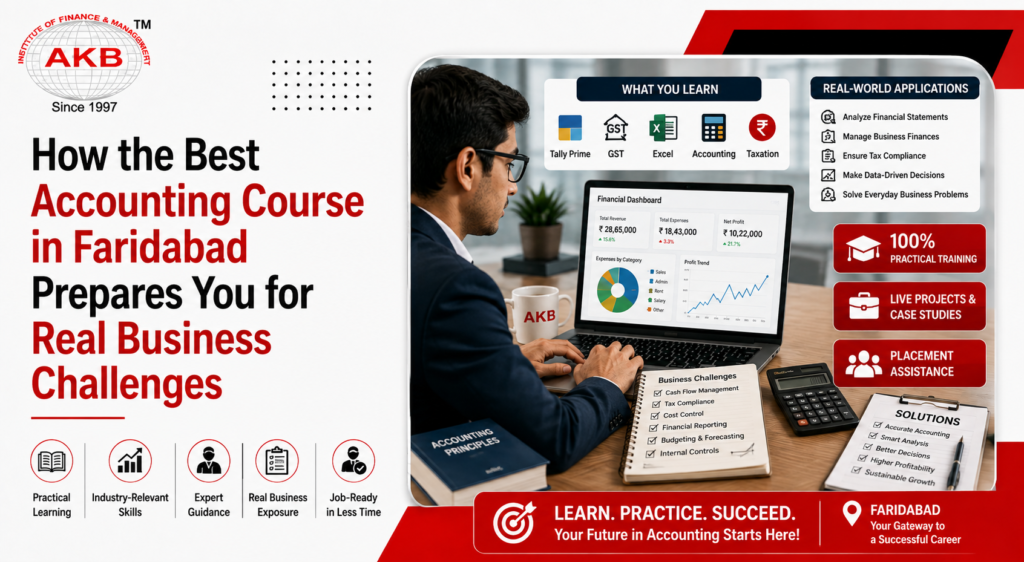
Institutes offering practical accounting education focus on closing this skill gap by exposing learners to workplace-style accounting environments. For example, programs at AKB Institute of Finance & Management include practical training in accounting, taxation, Tally, SAP, GST, BUSY, payroll, and Excel to help students develop industry-relevant capabilities.
Analysis: What Makes an Accounting Course Career-Focused?
Choosing an accounting course is not only about learning financial terminology. The right program should prepare learners to solve real business problems.
A comparison between traditional learning and practical accounting education highlights the difference:
| Traditional Accounting Learning | Practical Accounting Training |
| Focuses mainly on concepts | Focuses on the application |
| Limited software exposure | Hands-on software practice |
| Academic assignments | Real business scenarios |
| Knowledge-based approach | Skill-based approach |
| Exam preparation focus | Career preparation focus |
A career-oriented accounting program helps learners develop:
Software Proficiency
Modern accountants must understand the digital tools used by companies. Knowledge of accounting software improves productivity and workplace confidence.
Taxation Understanding
GST, income tax, and compliance processes are important parts of business accounting. Practical exposure helps learners understand how taxation works in daily operations.
Financial Reporting Skills
Businesses depend on accurate reports for decision-making. Training helps students understand how financial information is prepared and interpreted.
Problem-Solving Ability
Real accounting situations often involve errors, reconciliation issues, and compliance challenges. Practical learning prepares students to handle these situations effectively.
Common Mistakes Students Make While Choosing Accounting Training
Many students select accounting programs based only on duration or certification without checking whether the course develops practical abilities.
Some common mistakes include:
Choosing Theory-Only Programs
A course without practical assignments may not prepare students for workplace responsibilities.
Ignoring Software Training
Accounting software knowledge is now an essential requirement for most finance roles.
Focusing Only on Certificates
A certificate adds value, but employers prioritize skills and practical confidence.
Not Learning Additional Finance Skills
Combining accounting with GST, payroll, Excel, or SAP creates better career opportunities.
Recommendations: How to Choose the Right Accounting Course
Students planning a career in accounting should evaluate training programs based on industry relevance rather than just course names.
Before enrolling, consider these factors:
- Does the course include practical accounting projects?
- Are industry-standard software tools covered?
- Are GST and taxation modules included?
- Do trainers have professional experience?
- Is placement guidance provided?
- Does the curriculum match current employer requirements?
The best accounting course in Faridabad should help learners become comfortable with real accounting responsibilities before entering the job market.
A strong learning pathway usually combines:
- Accounting fundamentals
- Tally training
- GST knowledge
- SAP exposure
- Payroll understanding
- Excel skills
- Financial reporting practice
This combination creates a complete professional profile that matches modern business expectations.
Closing Thoughts
The accounting industry is no longer limited to maintaining records and preparing statements. Businesses today need professionals who can manage digital accounting systems, understand taxation, analyze financial information, and support business decisions.
Choosing the best accounting course in Faridabad allows students and professionals to gain practical skills that directly connect with workplace requirements. A training program focused on real business challenges helps learners become more confident, employable, and prepared for long-term career growth.
With practical learning modules, software-based training, industry-focused curriculum, and career-oriented guidance, AKB Institute of Finance & Management (AKBIFM) helps aspiring accounting professionals develop the skills required to succeed in today’s competitive finance industry.