A commerce graduate may walk into an accounting interview with a strong understanding of debit, credit, balance sheets, and basic taxation. Yet when the interviewer asks how a GST-related transaction should be recorded or how accounting software is used for routine financial work, theoretical knowledge may suddenly feel insufficient.
While a commerce graduate may enter an accounting job interview with good knowledge of debits, credits, balance sheets, and taxation, he or she may find that theoretical knowledge is not enough once asked about the method of recording a GST-based transaction or the usage of accounting software in doing regular financial calculations.
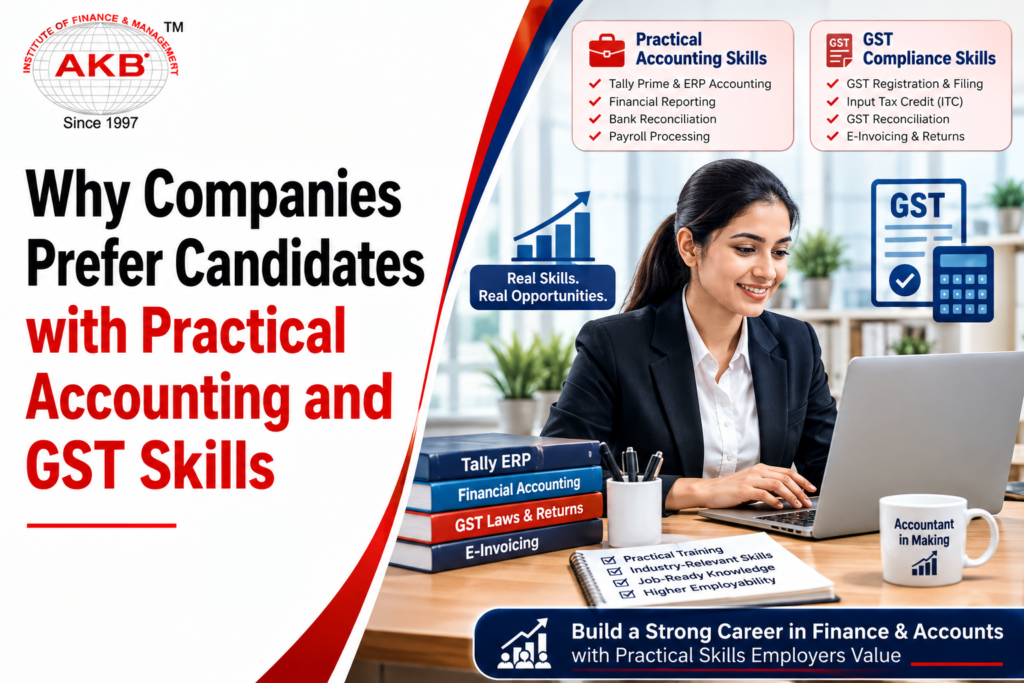
This is just one of many reasons why it is becoming increasingly important for potential employers to look for candidates capable of linking theory with practice. The work of an accounting department requires not only knowledge of financial terms but also the ability to use invoices, ledgers, GST, reconciliations, software, and other financial documents.
This way, a GST training course in Faridabad may become an effective tool for building finance skills suitable for workplace practice.
Why Practical Accounting Skills Matter to Employers
Accounting departments function in reality. In the morning, an employee has to do accounts of purchases; they will have to verify invoices, reconcile accounts, and deal with tax-related matters by the end of the day.
Thus, an employer wants to hire people who can put knowledge into practice. Practical knowledge will allow decreasing the period of training and making a beginner more effective faster.
The contemporary accounting job may include many functions, such as bookkeeping, taxation, accounting, payroll, computer operations, and financial analysis. People who understand the interconnections between these processes will show themselves as more versatile professionals.
GST Has Become Part of Everyday Accounting
GST is not limited to specialised tax departments. Its impact can appear in sales invoices, purchase entries, input tax credit, ledgers, reconciliation, and other accounting activities.
For this reason, students pursuing accounting careers can benefit from understanding how GST interacts with routine financial transactions.
A practical GST training course in Faridabad can help learners understand this connection through examples based on business transactions rather than relying exclusively on textbook explanations.
Expert Commentary
What Do Employers Expect from Entry-Level Accounting Candidates?
Employers generally want candidates who can demonstrate accuracy, adaptability, software familiarity, and an understanding of basic business processes. A certificate can support a candidate’s profile, but practical ability is what helps demonstrate whether the learner can handle workplace responsibilities.
For accounting and finance candidates, useful capabilities include:
- Understanding basic accounting principles
- Recording financial transactions accurately
- Preparing and checking invoices
- Understanding GST concepts
- Working with accounting software
- Maintaining organised financial records
- Performing basic reconciliation
- Understanding taxation-related documentation
A candidate who can explain how these skills work together is more likely to demonstrate genuine job readiness.
Why GST and Accounting Skills Work Better Together
GST knowledge becomes more meaningful when learners understand its accounting impact. For example, knowing the definition of input tax credit is useful, but understanding how a purchase transaction affects accounting records provides deeper practical knowledge.
Similarly, learning about GST return filing without understanding the underlying sales and purchase records can make the process difficult to apply in an actual workplace.
A GST training course in Faridabad that integrates accounting fundamentals, taxation concepts, and software practice can therefore provide a more complete learning experience.
Proof & Real-World Perspective
A Simple Business Example
Consider a small business that purchases goods from suppliers and sells them to customers. Its accounts team must maintain purchase and sales records, review invoices, record applicable taxes, and keep financial information organised.
A candidate with only theoretical accounting knowledge may understand the terminology but struggle to process the transactions efficiently.
A practically trained candidate, however, can approach the same situation by considering the accounting entry, invoice details, GST implications, and documentation requirements together.
This distinction matters because real accounting work rarely arrives as a neatly separated textbook chapter. Several responsibilities often overlap within a single transaction.
Accounting Software Makes Practical Training More Important
Technology has transformed accounting work. Businesses increasingly depend on digital accounting systems for bookkeeping, invoicing, reporting, and financial record management.
However, software does not remove the need for human understanding. An accountant still needs to identify incorrect entries, understand unusual transactions, check financial information, and recognise when something requires further review.
That is why software training should complement accounting and taxation knowledge rather than replace it.
Analysis
Why Companies Prefer Multi-Skilled Accounting Candidates
Employers can benefit from candidates who are capable of handling more than one part of the accounting workflow. A professional who understands bookkeeping, GST, Excel, and accounting software may be able to support different tasks within a finance department.
This does not mean that every fresher must master every financial function immediately. Instead, it highlights the value of developing a strong combination of foundational and practical skills.
Five Skills That Can Improve Job Readiness
1. Accounting Fundamentals
A strong foundation in journal entries, ledgers, trial balances, financial statements, and basic accounting principles helps candidates understand the logic behind financial records.
2. GST Knowledge
Understanding GST concepts, invoices, input tax credit, and compliance-related processes can help candidates handle taxation-linked accounting responsibilities.
3. Accounting Software
Knowledge of tools such as Tally and other commonly used financial systems can make candidates more comfortable with digital accounting workflows.
4. Reconciliation Skills
Reconciliation requires attention to detail and the ability to identify differences between financial records. It is a valuable practical skill for accounting professionals.
5. Communication and Accuracy
Accounting professionals often communicate with managers, vendors, customers, auditors, and other departments. Clear communication and careful documentation are therefore essential workplace skills.
Recommendations
How Should Students Build Practical Accounting Skills?
Students should avoid treating accounting education as a collection of isolated subjects. Instead, they should look for opportunities to connect accounting, taxation, software, and business processes.
When evaluating a GST training course in Faridabad, learners should consider whether the programme provides:
- Practical transaction-based exercises
- GST concepts explained through business examples
- Accounting software exposure
- Invoice preparation and checking
- Reconciliation practice
- Taxation-related accounting scenarios
- Guidance from experienced trainers
- Industry-oriented assignments
- Career and interview preparation
The objective should be to understand the process, not simply complete the syllabus.
How Can Freshers Stand Out During Interviews?
Candidates can strengthen their interview performance by being prepared to discuss practical scenarios. Instead of only stating that they have studied GST, they should be able to explain how GST knowledge relates to accounting transactions.
They can also build confidence by practising common accounting tasks repeatedly. Creating sample invoices, recording transactions, working with ledgers, performing reconciliation exercises, and using accounting software can make technical concepts easier to recall during interviews.
A GST training course in Faridabad becomes particularly valuable when this kind of practical exposure is included in the learning process.
What Should Working Professionals Consider?
Professionals already working in accounting can also benefit from upgrading their taxation and software skills. As businesses adopt new digital processes and financial responsibilities become more interconnected, continuous learning can help professionals remain relevant.
Rather than learning GST as a standalone subject, working professionals can combine it with advanced Excel, accounting software, payroll, MIS reporting, or financial analysis according to their career goals.
Closing Thoughts
Companies need accounting professionals who can do more than record numbers. They need people who understand how accounting transactions connect with taxation, software, documentation, compliance, and broader business operations.
Practical training can help students make this transition from classroom concepts to workplace responsibilities. A well-structured GST training course in Faridabad can strengthen taxation knowledge while supporting broader accounting and finance skills.
For students and aspiring professionals seeking industry-focused training, AKB Institute of Finance & Management can provide an environment focused on practical learning and career-oriented financial education. Building accounting and GST skills together can help learners approach the job market with greater confidence, stronger technical knowledge, and a more practical understanding of how finance works in real businesses.