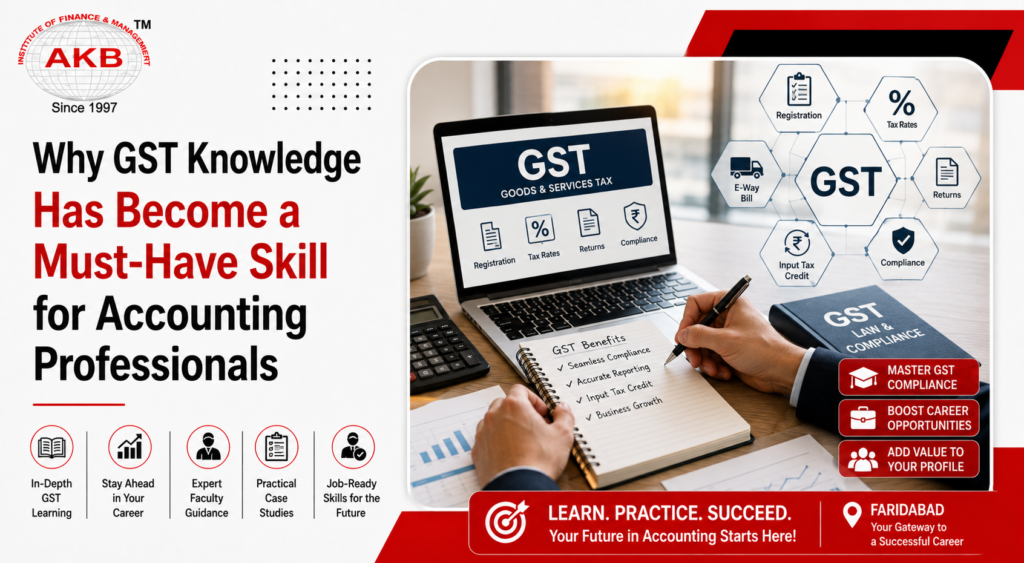
Though the accountant might be familiar with recording sales, purchases, expenses, and payments properly, he or she can encounter problems when the business asks questions regarding GST returns, input tax credit, tax invoices, or any other compliance requirements. This is now quite common as accounting in today’s world has expanded its scope beyond just keeping the books.
GST has become an integral part of the finance professional’s daily accounting routine. There is a need for someone who is able to handle transactions, apply relevant GST provisions, keep the accounts, and facilitate compliance. It is, therefore, no surprise that practical knowledge about GST has become an essential career asset for students and professionals alike.
Such a practical GST course in Faridabad can easily be found.
Industry Insight
Why GST Knowledge Matters in Modern Accounting
The adoption of GST has changed the manner in which organizations handle indirect taxes in India. No longer does taxation remain an entirely different aspect that needs to be handled separately; many organizations have now started to expect the professionals working in accounting to know the impact of GST in their day-to-day transactions.
The accountant may come across GST issues in invoicing, purchase, transaction reconciliation, input tax credit, return preparation, among other such tasks. Hence, knowledge about taxation becomes essential for handling accounting tasks.
In addition, the increasing use of accounting software has resulted in a change in the job profile of an accountant. While software helps in calculating and generating various reports, it is still necessary for professionals to know what the generated data implies and recognize any mistakes made in the process.
Herein, practical GST training proves to be useful.
GST Is Closely Connected With Accounting
GST should not be viewed as an isolated taxation subject. It interacts with several accounting activities, including:
- Sales and purchase accounting
- Tax invoice preparation
- Input tax credit recording
- Ledger management
- Tax liability calculation
- Reconciliation of financial records
- GST-related reporting and compliance
Understanding these connections can help professionals work more confidently with finance teams and business owners.
Expert Commentary
What Should Students Learn Beyond GST Theory?
Learning GST definitions and terminology is only the starting point. Employers generally benefit from professionals who can apply their knowledge while working with financial records and accounting systems.
A well-designed GST course in Faridabad should therefore combine taxation concepts with practical accounting applications. Learners should understand not only what GST is but also how GST-related transactions are handled in business environments.
Practical training can introduce learners to situations such as recording taxable sales, understanding purchase transactions, checking tax calculations, and working through compliance-oriented scenarios.
Practical GST Skills Can Strengthen Accounting Careers
GST knowledge can make an accounting professional more versatile because taxation appears across different types of businesses and finance roles.
For example, an accounts executive may need to review invoices and identify whether GST has been appropriately recorded. A junior accountant may assist with reconciliations. A finance assistant may organise transaction data required for compliance work.
Useful skills include:
- Understanding GST concepts and terminology
- Preparing and checking GST-related records
- Understanding input tax credit
- Working with accounting software
- Interpreting transaction-level tax information
- Maintaining organised financial documentation
- Understanding basic GST compliance processes
The objective is not simply to memorise provisions. It is to develop the ability to apply taxation knowledge accurately in an accounting environment.
Proof & Real-World Perspective
Consider a Typical Business Accounting Scenario
Imagine a growing business handling dozens or hundreds of transactions every month. Its accounting team records sales and purchases, maintains ledgers, checks invoices, and prepares financial reports.
If an employee understands only basic bookkeeping, they may record transactions without recognising potential GST-related issues. A professional with accounting and GST knowledge can look at the same transaction from both perspectives: the accounting impact and the taxation requirement.
That difference can improve the quality of financial work.
Similarly, when accounting records do not match GST-related information, professionals with practical knowledge are better positioned to investigate the discrepancy instead of treating reconciliation as a purely technical exercise.
Software Skills and GST Knowledge Work Together
Modern accounting environments frequently use digital tools for bookkeeping, invoicing, reporting, and taxation-related work. However, software proficiency alone does not replace financial understanding.
A learner who combines GST knowledge with accounting software skills can better understand:
- Why a transaction is recorded in a particular way
- How tax information affects accounting records
- Where errors may occur
- How financial data should be reviewed
- Why accurate documentation matters
This combination is particularly useful for entry-level professionals seeking roles in accounts, taxation, finance operations, and bookkeeping.
Analysis
What Career Advantages Can GST Knowledge Provide?
The value of GST knowledge comes from its practical connection with business operations. Professionals who understand both accounting and taxation can potentially take on a broader range of responsibilities than those with only basic bookkeeping knowledge.
A GST course in Faridabad can contribute to career development in several ways.
1. Broader Accounting Responsibilities
GST knowledge allows professionals to participate in activities beyond routine data entry. They can support invoice verification, transaction review, reconciliation, and compliance-related work.
2. Better Workplace Readiness
Practical training can reduce the gap between classroom learning and workplace expectations. Students become familiar with the type of accounting and taxation situations they may encounter after joining an organisation.
3. Stronger Taxation Understanding
GST is an important component of indirect taxation in India. Building a clear foundation can also make it easier for learners to understand broader taxation concepts as they progress professionally.
4. Improved Use of Accounting Software
When GST concepts are understood alongside accounting software, learners can develop a more complete understanding of how financial transactions are processed digitally.
5. More Versatile Career Options
GST and accounting skills can support entry-level opportunities across businesses, accounting firms, finance departments, and other organisations that require financial record management and compliance support.
Recommendations
How Should You Choose GST Training?
Not every taxation course provides the same level of practical exposure. Students should look beyond the course title and examine what they will actually learn and practise.
Before selecting a GST course in Faridabad, consider whether the training includes:
- Practical accounting and taxation exercises
- GST concepts explained through business examples
- Exposure to accounting software
- Invoice and transaction-based practice
- Reconciliation-related learning
- Guidance on common accounting mistakes
- Trainers with relevant practical experience
- Career-oriented and industry-focused training
The strongest learning experience is one where students understand the reasoning behind accounting and taxation processes rather than simply following instructions.
Why Practical Learning Should Be a Priority
GST regulations and business processes can evolve, so memorising outdated examples is not enough for long-term professional development. Learners should develop foundational concepts and practical problem-solving abilities that can be applied as requirements change.
For students planning careers in accounting and finance, GST training can therefore work best as part of a broader skill set that includes bookkeeping, Tally or other accounting software, Excel, financial reporting, payroll, and communication skills.
Closing Thoughts
GST knowledge has moved from being a specialised taxation skill to an important part of modern accounting practice. Professionals who understand how taxation connects with bookkeeping, invoicing, reconciliation, software, and financial reporting can approach workplace responsibilities with greater confidence.
Choosing a practical GST course in Faridabad can help students and aspiring accounting professionals build skills that connect classroom concepts with real business situations. For learners looking for industry-focused finance education, AKB Institute of Finance & Management can provide a structured environment to develop practical accounting and taxation knowledge.
The goal is not simply to learn GST. It is to understand how GST fits into the wider financial operations of a business and use that knowledge to build a stronger, more adaptable accounting career.