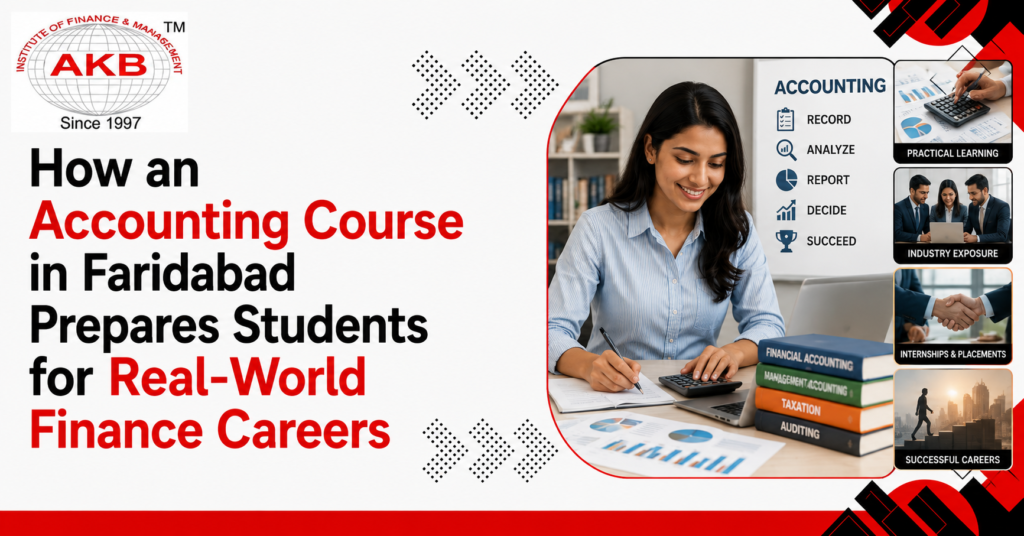
There are many commerce graduates who have a good command of accounting concepts but find it difficult to deal with real-life job requirements. At present times, employers are not only looking for candidates with accounting knowledge but are seeking individuals who can create financial statements, handle taxes, work on accounting software, and solve business-related issues without any problem. An accounting course in Faridabad proves to be very helpful for the candidates since it helps them learn practical finance skills that employers need in their workplaces.
Why are Practical Finance Skills Important in the Present Times?
The finance sector has changed to a large extent in the last decade. Businesses run using accounting software and various other accounting tools and techniques. This is why individuals with accounting knowledge need to play a role not only in bookkeeping but in other processes as well.
The accounting class in Faridabad teaches students about the role of accounting in helping businesses make decisions, rather than just maintaining records of financial dealings. In place of studying concepts independently, students learn how buying, selling, taxes, wages, stock, and accounting are all connected.
For instance, balance sheet preparation takes on greater significance when students know the effect of day-to-day dealings on the performance of the whole business. This helps students develop a mindset of financiers rather than that of examinees.
How Practical Training Bridges the Gap Between Education and Employment
One of the biggest challenges faced by fresh graduates is the gap between academic learning and employer expectations. Most companies expect recruits to understand business workflows, accounting software, and compliance processes without extensive onboarding.
Professional accounting training focuses on practical exposure through:
- Live accounting projects
- Real business case studies
- GST compliance exercises
- Financial reporting practice
- Business documentation
- Software-based accounting
Many institutes also integrate software such as Tally, SAP, BUSY, Computax, and Microsoft Excel into their curriculum because these tools are widely used by businesses today. Practical exposure to these platforms helps students adapt more quickly to workplace environments.
Skills Students Develop During an Accounting Course
A quality accounting course in Faridabad develops much more than technical accounting knowledge. Students gradually build analytical thinking, financial accuracy, software proficiency, and business understanding.
Some of the most valuable skills include:
- Financial accounting
- Bookkeeping
- GST accounting
- Payroll processing
- Bank reconciliation
- Financial statement preparation
- MIS reporting
- Business communication
- Microsoft Excel for finance
- ERP software exposure
These skills make graduates suitable for various accounting and finance roles across industries.
For example, a retail company requires professionals to manage inventory-linked accounting, while manufacturing businesses rely heavily on cost accounting and ERP systems. Practical training prepares students for such diverse business environments.
Why Employers Prefer Candidates with Practical Accounting Training?
Recruiters increasingly evaluate candidates based on their ability to solve workplace problems rather than simply recall accounting definitions. Businesses want professionals who understand workflows, software systems, compliance requirements, and financial reporting standards.
Candidates who have completed an accounting course in Faridabad often stand out because they possess practical exposure alongside theoretical knowledge.
Employers particularly value candidates who can:
- Handle accounting software confidently.
- Prepare financial reports accurately.
- Understand GST and taxation procedures.
- Perform bank reconciliations independently.
- Work with business documents.
- Adapt quickly to organizational processes.
This reduces the training burden for employers while increasing productivity from the very beginning.
Building Long-Term Career Opportunities in Finance
Accounting remains one of the most stable and versatile career fields because every organization requires financial management. However, career growth today depends largely on continuous skill development.
Practical accounting education creates opportunities across sectors, including:
- Manufacturing
- Healthcare
- Retail
- Banking
- Construction
- Logistics
- E-commerce
- Professional services
Students may begin their careers as Accounts Executives, Junior Accountants, Finance Assistants, Payroll Executives, or GST Associates before progressing toward senior finance positions.
As professionals gain experience, additional expertise in SAP, taxation, financial analysis, or management accounting can open opportunities in corporate finance, auditing, compliance, and financial planning.
This makes practical accounting education a long-term investment rather than simply a short-term certification.
How to Choose the Right Accounting Course for Career Success
Not every training program delivers the same outcomes. Students should evaluate an institute based on practical exposure rather than course duration alone.
Before enrolling, consider whether the course includes:
- Industry-relevant curriculum
- Live practical assignments
- Accounting software training
- Experienced faculty
- Placement support
- Resume preparation
- Interview guidance
- Flexible learning options
Programs that combine classroom instruction with real business scenarios tend to produce graduates who are more confident and workplace-ready.
Institutes that also provide career guidance, interview preparation, and exposure to multiple accounting software platforms can significantly improve students’ employment prospects. AKB Institute of Finance & Management emphasizes practical bookkeeping, software training, one-to-one support, and placement assistance as part of its learning approach.
Final Thoughts
Choosing an accounting course in Faridabad is about much more than earning a certificate. It is about developing the practical knowledge, technical skills, and professional confidence required to succeed in today’s finance industry. As businesses continue adopting digital accounting systems and integrated financial processes, employers increasingly value candidates who can contribute from day one. By combining accounting fundamentals with software expertise, live projects, and real-world business exposure, institutes such as AKB Institute of Finance & Management (AKBIFM) help students build strong foundations for long-term careers in accounting and finance while preparing them for the evolving expectations of modern employers.