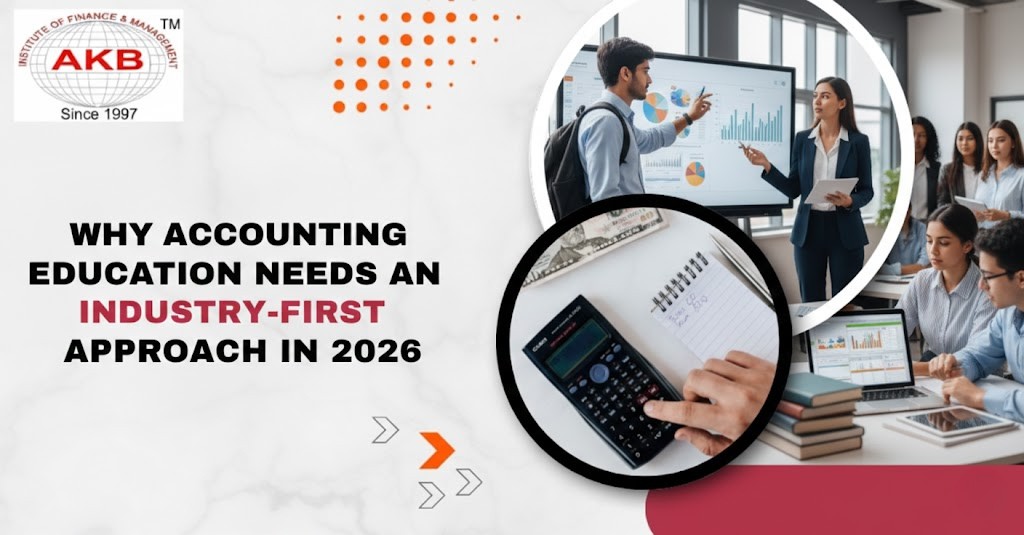
The field of accounting is experiencing a significant change, with businesses requiring individuals who can make contributions on the first day. The ancient style of learning in the classroom that places a lot of emphasis on theory does not suffice to sustain the demands of the modern industry. By the year 2026, accountants are going to be software and compliant, and be able to interpret financial information to make decisions.
It is this widening divide between educational credentials and professional demands that has made Industry-first accounting education a necessity. It is more practical and job-first-ready, learning skills and worlds, and not area skills, and thus mapping priorities, making students more confident and employable in the professional context.
The Changing Expectations from Accounting Professionals
Accountants have also been empowered to go beyond the simple book keeping and compliance work. Employers are now demanding accounting professionals to have an idea of how to prioritize, ananalyzed financial information and assist in making decisions by management.
This development implies that accounting education should be in line with the recent practice in the industry. Students in most cases fail to adjust the actual working environments, even without receiving an Industry-first accounting education.
Why expectations are changing
- Companies are dependent on up-to-date financial data.
- Manual accounting has been minimized with automation.
- Laws of compliance are getting sophisticated.
- Accountants are engaged in strategic planning.
Why Traditional Accounting Education Is Falling Short
Conventional accounting training is very text oriented,though essentials matter, this model tends to disregard the practical skills required in the contemporary workplace.
Students who attend programs that are based solely on theory do not get exposure to accounting programs, actual business situations, and compliance processes. This gap has underscored Industry-first accounting education in 202exam-oriented,6.
Limitations of theory-based learning
- Little exposure to accounting software.
- Absence of practical problem-solving.
- Inadequate knowledge of business processes.
- Low employment preparation following course completion.
Practical Skills Are the New Foundation of Accounting Careers
In the contemporary business environment, practical knowledge is treated with more importance compared to memorized ideas. Employers would like to hire individuals who are able to perform actual accounting duties, including GST filing, payroll, MIS, reporting payroll,, and reconciliation.
The accountancy education that will be taught in the industry will be the first of its kind, which means that the students will learn through doing rather than by reading, and this instills confidence and competence.
Key Practical Skills Students Must Learn
- Software-based accounting operations.
- GST, TDS, and compliance management.
- Statutory reporting and payroll.
- Financial reporting and analysis.
Industry Tools and Software Are No Longer Optional
Tally, SAP FICO, Excel, and cloud-based systems are some of the tools that are used in modern accounting. The students are not able to meet the expectations of the employer without practical training in these tools.
The Industry-first accounting education approach incorporates these tools as part of the curriculum so that students do not leave the university with skills that are not applicable in practice.
The Importance of Software Exposure.
- Organizations run on accounting programs.
- The accounting positions are becoming less manual.
- The efficiency is enhanced through software skills.
- The employers emphasize employment-ready candidates.
Live Business Scenarios Improve Decision-Making Skills
Students of accounting must be subjected to situations in real business emphasizes make them appreciate the implications of financial decisions to businessesforthe operations. Real life for-life experience will help students to put concepts to practical use.
The Industry-first accounting education,-life which takes into account case studies, live projects, and real data analysis, and familiarizes students with the challenges in the workplace.
Advantages of the Real-Life Exposure.
- Enhances the power of thought.
- Develops problem-solving capacity.
- Increases decision-making, accounting, and confidence.
- Minimizes the learning curve at work.
Compliance Knowledge Needs Practical Application
Tax, GST, payroll practice, and regulatory compliance are getting more complicated. Businesses have high expectations of accountants to not only file returns but also to offer advice on estate planning and risk reduction.
One of these is an industry-first method, which instructs using actual filing and case studies, as opposed to theory, alone alone..
Why Compliance Training must be Practical
- Reduces mistakes in filings
- Enhances audit preparedness.
- Develops regulatory trust.
- Brings consultative value to the position.
Employers Prefer Job-Ready Accountants in 2026
Recruitment has been transformed radically. Employers are no longer ready to take months of time trying to train freshers at the bottom line. They would like candidates who are willing to contribute instantly.
With this preference, Industry-first accounting education is a major determinant of employability and career development.
What Employers Look for
- Software proficiency
- Compliance awareness
- Business understanding
Short-Term Skill-Oriented Learning Is Gaining Importance
Prolonged academic courses are giving way to concentrated training modules, which are based on skills. Learners and practitioners desire quicker payback on the learning investment.
A job-orientated model provides industry-first learning, which assists the candidates in being skill-based and being introduced into the workforce earlier.
Advantages of Skill-Focused Programs
- Faster career entry
- Lower training-to-job gap
- Clear career direction
- Better return on education
How Industry-First Education Shapes Long-Term Careers
Accountants who are trained in an industry-first long-term mentality develop more quickly in their careers. They move to advisory, managerial, and strategic positions since they are familiar with both the numbers and the business environment.
Such a strategy not only increases the chances of getting jobs or working in the first place but also enhances long-term work relevance.
Long-Term Benefits
- Higher salary growth
- Improved promotional facilities.
- Effective professional confidence.
- Flexibility to the changes in the industry.
Conclusion
Due to the changing nature of business and the transformation of finance functions under the influence of technology, accounting education should follow the trends in the industry. To make it through the accounting career in 2026, having theoretical knowledge will not be enough to succeed. The first accounting Industry-first accounting education since it is oriented to practical skills, real-life exposure, and job preparation, and it is the most effective way to learn for future professionals.The role of institutions such as AKB Institute of Finance and Management (AKBIFM) is essential in this change, as they provide training that is relevant to the industry and to which students can be subjected to get a real accounting position, rather than the exams. Through an industry-first approach, learners are able to acquire the confidence, competence, and clarity required to succeed in the contemporary accounting career.